Full control over your operational resilience
A spreadsheet cannot show what breaks when dependencies collapse. Yet emergency plans and risk audits remain scattered across isolated departments without cohesion.
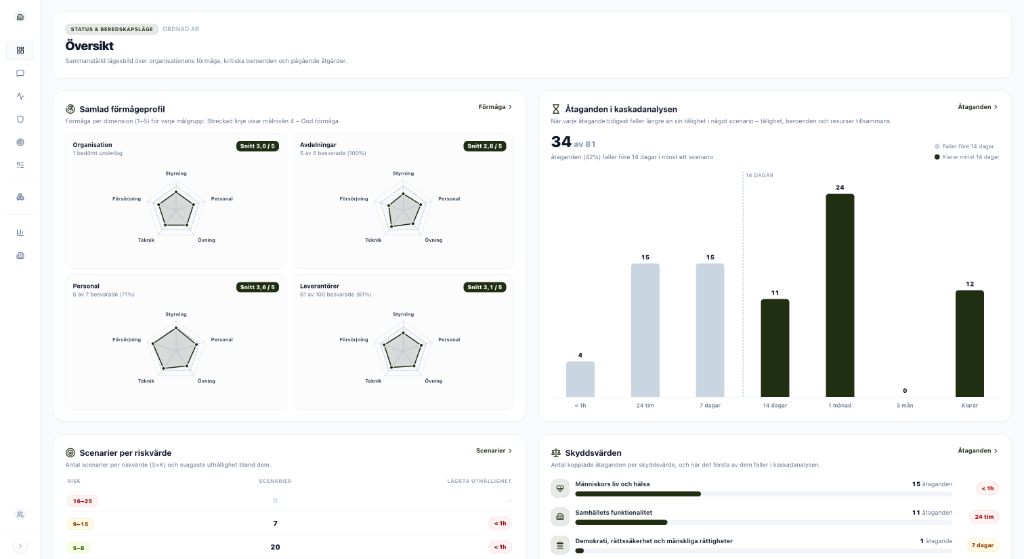
With ORDNAD, your entire organization gathers into one single operational picture. Unit heads, staff, and contractors answer focused inquiries for their remit. You instantly see how dependencies connect, simulate crisis scenarios, and resolve bottlenecks before disaster strikes.
Never start from scratch
If you already have risk audits in Word, Excel, or PDF, we import them into ORDNAD. If you are starting fresh, we guide you step by step.
Zero manual email chasing
Unit heads, staff, management, and key suppliers answer targeted questions directly into your unified operational model.
Simulate before crisis hits
Stress-test operations against realistic disruptions to expose cascading dependencies, shared bottlenecks, and actual buffer endurance.
Audit-ready for tenders
Generate verified reports when institutional clients, public tenders, or the board request documented continuity assurance.
From mapping to simulation and executive reporting
ORDNAD builds on established methodologies civil resilience planners trust: FORSA and KDU. When departments update operational data, changes cascade throughout the chain instantly.
Build a new analysis in ORDNAD, or import existing files.
Drafting a thorough risk and vulnerability assessment traditionally takes months of manual coordination. In ORDNAD, you start from a proven model connecting operational commitments with dependencies and resources.
If you already have risk registers in Word, Excel, or PDF, we ingest them directly into ORDNAD. Your previous work is preserved and elevated into an active scenario engine.
- Import existing assessments: Convert fragmented files into a consolidated chain of commitments and dependencies.
- Dependency mapping: Trace what every commitment relies on: IT systems, personnel, key suppliers, and facilities.
- Effortless annual reviews: Update changing parameters year after year instead of starting from an empty sheet.
Direct the right questions to the right role.
Instead of distributing exhaustive spreadsheets across departments, team leaders and vendors respond through a seamless web link.
Managers, engineers, operations, and suppliers receive questions strictly restricted to their operational domain. Responses automatically consolidate into a single executive dashboard.
- Browser link collection: Respondents answer cleanly directly on any mobile or desktop browser.
- Five core capability pillars: Inquiries evaluate readiness across Governance, Staff, Technology, Supply Chains, and Exercises.
- Automated aggregation: Eliminates weeks of manual copy-pasting for the security and resilience team.
Observe how disruptions cascade across operations over time.
Static matrices cannot reflect dynamics when disruptions spread. In ORDNAD, scenarios like prolonged blackouts, cyberattacks, or geopolitical crises propagate through the chain of commitments, dependencies, and resources.
Cascade analysis reveals how outages amplify over time. You see which dependencies collapse first and where mitigation yields maximum impact.
- Chronological cascade analysis: Determine the exact order dependencies fail and when commitments become untenable.
- Shared single points of failure: Identify whether multiple departments depend on the same critical supplier or cloud system.
- Pre-configured scenario catalogue: Includes 32 standardized crisis situations across three severity tiers, with support for custom events.
Doubling onsite fuel reserves and establishing satellite backup extends chain endurance to two weeks.
Auditable documentation for tenders, leadership, and boards.
Enterprise clients and public authorities increasingly demand proof of crisis continuity. With ORDNAD, your documentation is prepared before inquiries arrive.
The platform generates prioritized action plans with assigned owners and deadlines, alongside formal preparedness statements tailored for procurement officers.
- Tender continuity documentation: Export verified preparedness sections when tenders demand delivery guarantees.
- Accountable action plans: Every mitigation measure is assigned an internal owner, priority, and timeline.
- Executive board summaries: Comprehensive risk summaries ready for review by the executive committee or board.
Engineered for organizations with strict security standards.
Data is stored nationally in your country and never utilized to train AI. The cloud architecture is built for operational data with granular role-based permissions and mandatory 2FA. For organizations with high-security mandates, ORDNAD can also deploy within your own infrastructure or in fully isolated environments.
Frictionless Survey Links
Unit heads and external contractors respond via browser links. Each unit is strictly compartmentalized to its own questions.
Unified Organizational Picture
Unit responses automatically combine into an interconnected operational model mapping dependencies to outputs.
Isolated Deployments
ORDNAD supports deployment on-premise or within air-gapped environments without external network connections.
Frequently Asked Questions about ORDNAD
We already have an existing risk assessment. Can we import it?
Yes. You do not need to restart your work. We ingest existing Word, Excel, or PDF risk assessments into ORDNAD, transforming static text into active models for cascade simulation.
Can ORDNAD run in our own environment?
Yes. ORDNAD can be deployed on-premise or within air-gapped networks. This is provided based on your organizational technical and compliance parameters.
How does decentralized survey collection work in practice?
Rather than burdening everyone with comprehensive questionnaires, managers and contractors receive focused links requiring no login. Responses consolidate automatically for the security team.
How does ORDNAD support tender proposals?
When procurement teams demand evidence of continuity and delivery assurance, ORDNAD generates a formal preparedness statement directly from your structured data, demonstrating compliance without exposing sensitive internal details.
What is the implementation timeline?
We lead the assessment alongside you. Your security team invests 6 to 8 hours during the initial onboarding pass, while managers spend 10 to 15 minutes on surveys. You retain 12 months access to the platform.
Gain full control over your operational resilience
Select a department or business unit to begin with. We demonstrate how your data models across the disruption engine.